.jpg)
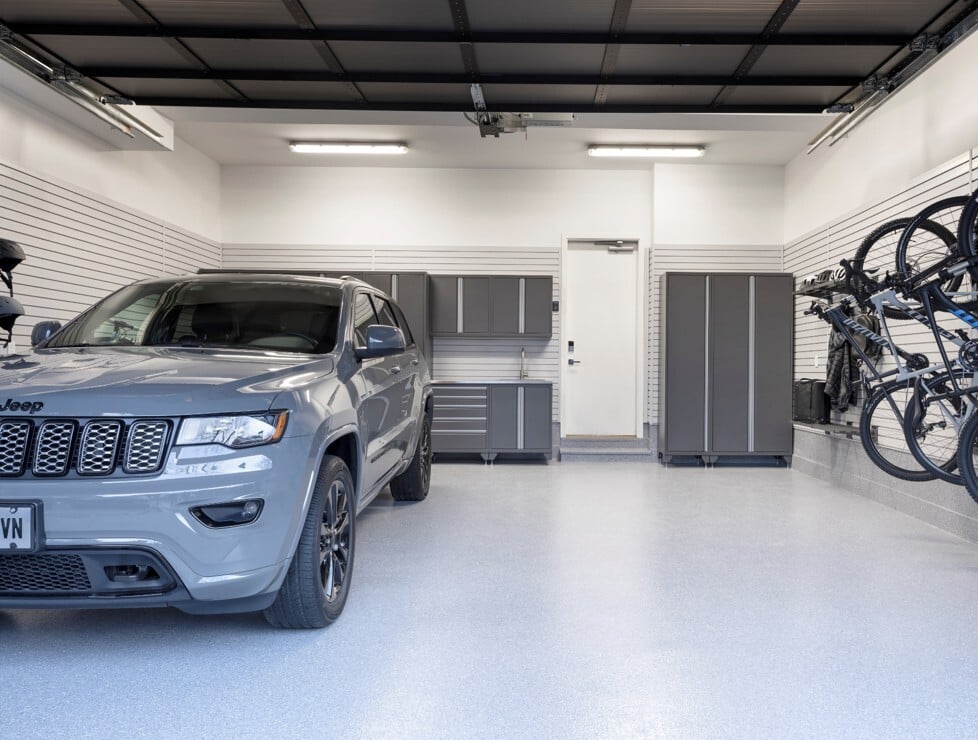
Table of contents
- The real reason your garage is still a mess
- What retail garage storage actually gives you
- What a professional garage storage system means
- Why design is the most underrated part of any garage renovation
- The quality gap: what you're really comparing when you compare price
- Your new garage storage decision tree
- FAQ: garage storage systems
1. The real reason your garage is still a mess
You've probably already bought the bins. Maybe a freestanding wire shelf from a big-box store, a few wall hooks, possibly a rolling cabinet that sounded good at the time. And yet, the garage still doesn't work.
The bikes still block the car. The sporting goods pile is somehow worse. Finding anything requires a small excavation.
Here's the hard truth people don't want to hear: the problem was never the stuff, but the strategy.
Homeowners tend to approach garage storage the way they approach a buffet. They grab what looks good in the moment, pile it in, and hope for the best. The result is a garage that holds more but functions worse. More containers, more shelving, more shuffling.
Garage storage fails for three consistent reasons:
- No system. Individual pieces — a shelf here, a hook there — don't add up to an organized space.
- Wrong product for the environment. Temperature swings, moisture, the weight of seasonal gear, tools, and vehicles all put serious stress on storage products. Retail options aren't built for it.
- No plan for how the garage is used. A garage used primarily for parking two cars requires a completely different storage layout than one used as a workshop, a sports hub, or a combination of all three.
If you've tried to fix your garage more than once without lasting results, the issue it's the approach. And the solution isn't to buy more, but to start thinking differently.
⟩ Top
2. What retail garage storage actually gives you
Walk into any home improvement store and you'll find walls of garage storage products: plastic shelving units, metal wire racks, peel-and-stick hooks, freestanding cabinet kits, and an overwhelming selection of bins in every color.
These products are not without merit. For a light-use garage with simple needs and a tight budget, some of them get the job done. But it's worth knowing exactly what you're getting, and what you're not.
What retail garage storage does well:
- Low upfront cost.
- Fast setup, no installation expertise needed.
- Widely available and easy to replace.
Where retail garage storage consistently falls short:
- Load limitations. A plastic shelf rated for 200 lbs sounds impressive until you learn that rating assumes perfectly even weight distribution under ideal conditions. Real garage loads (bulky equipment, heavy tool sets) rarely cooperate.
- No wall integration. Retail systems sit on the floor or hang from a single anchor point. They don't use your wall space strategically, and they don't adapt as your needs change.
- Durability problems. Freestanding metal shelving rusts. Plastic warps. Wire racks shift under uneven loads. What worked in Year One becomes safety concern by Year Three.
- No design cohesion. When you piece together storage over time from different stores and different product lines, the result is a visual jumble that makes the space feel chaotic even when it's technically organized.
- No consideration for parking. A common oversight in retail garage storage: the setup looks fine until you park the car. Then you realize the shelf sticks out too far, or the cabinet door swings into the hood, or there's no room to open the driver's side door. A garage is a parking space first. Storage has to work around that.
The fundamental issue with retail garage storage isn't that the products are bad. It's that individual products don't solve a system problem. Buying better shelves is like buying a better pen when what you need is a better plan.
⟩ Top
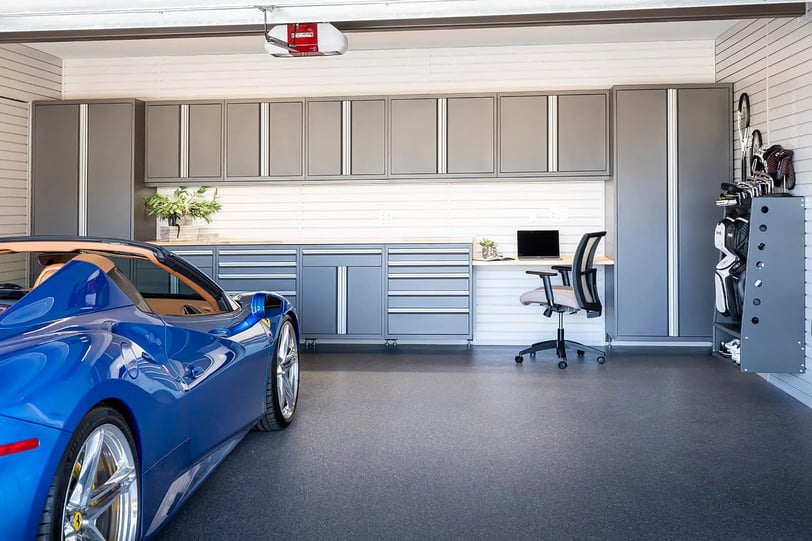
3. What a professional garage storage system means
Professional garage storage is a fundamentally different category, not just in terms of materials, but in terms of how the whole project is conceived.
When you work with a professional garage organization company like Garage Living, you're not shopping for products. You're designing a space.
Here's what that distinction looks like in practice:
Custom layout planning. A professional system starts with your specific garage: its dimensions, its obstructions (doors, windows, utility panels), how many vehicles you park there, and how you use the non-parking space. Nothing is guessed at. Everything is measured.
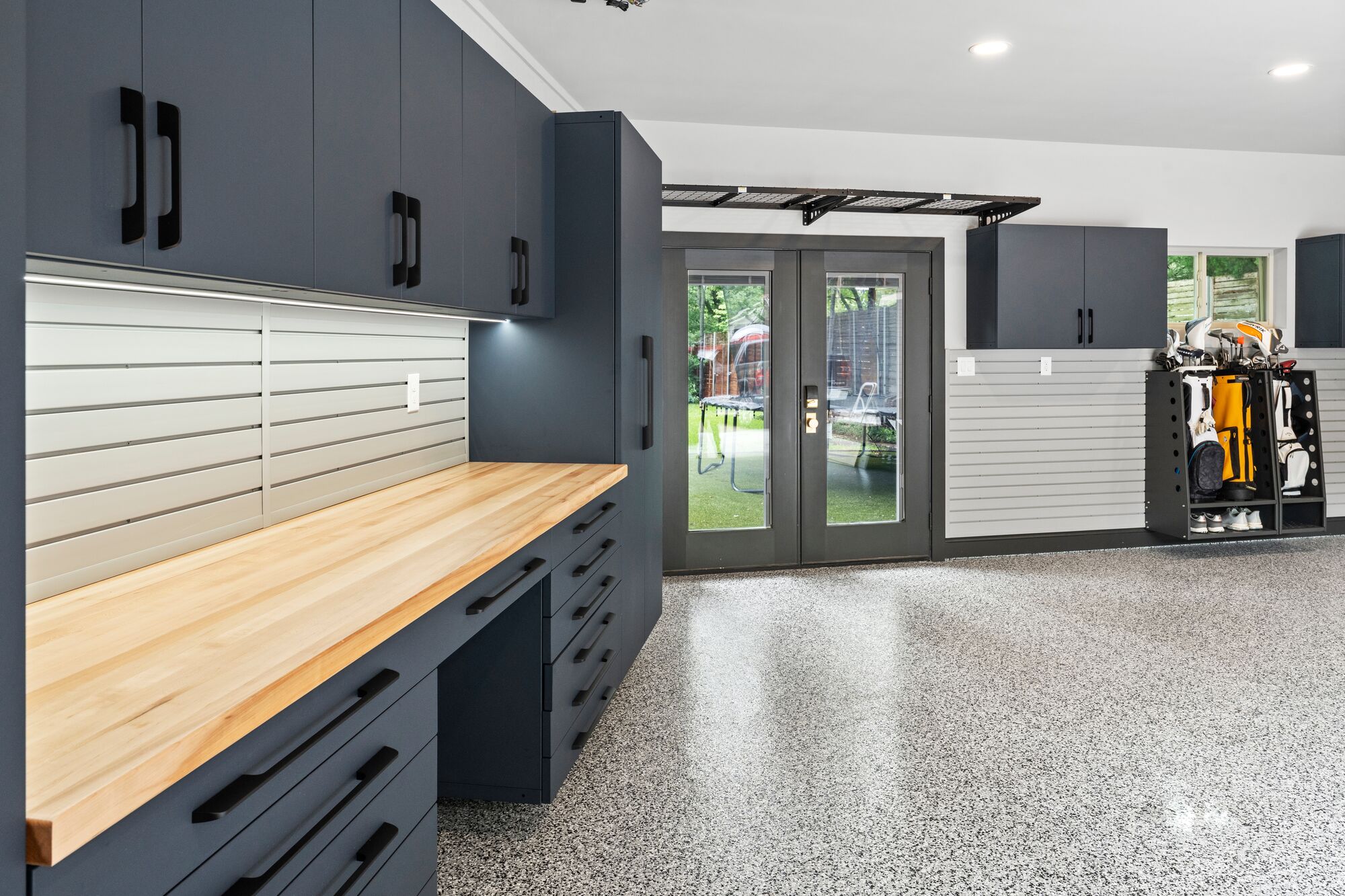
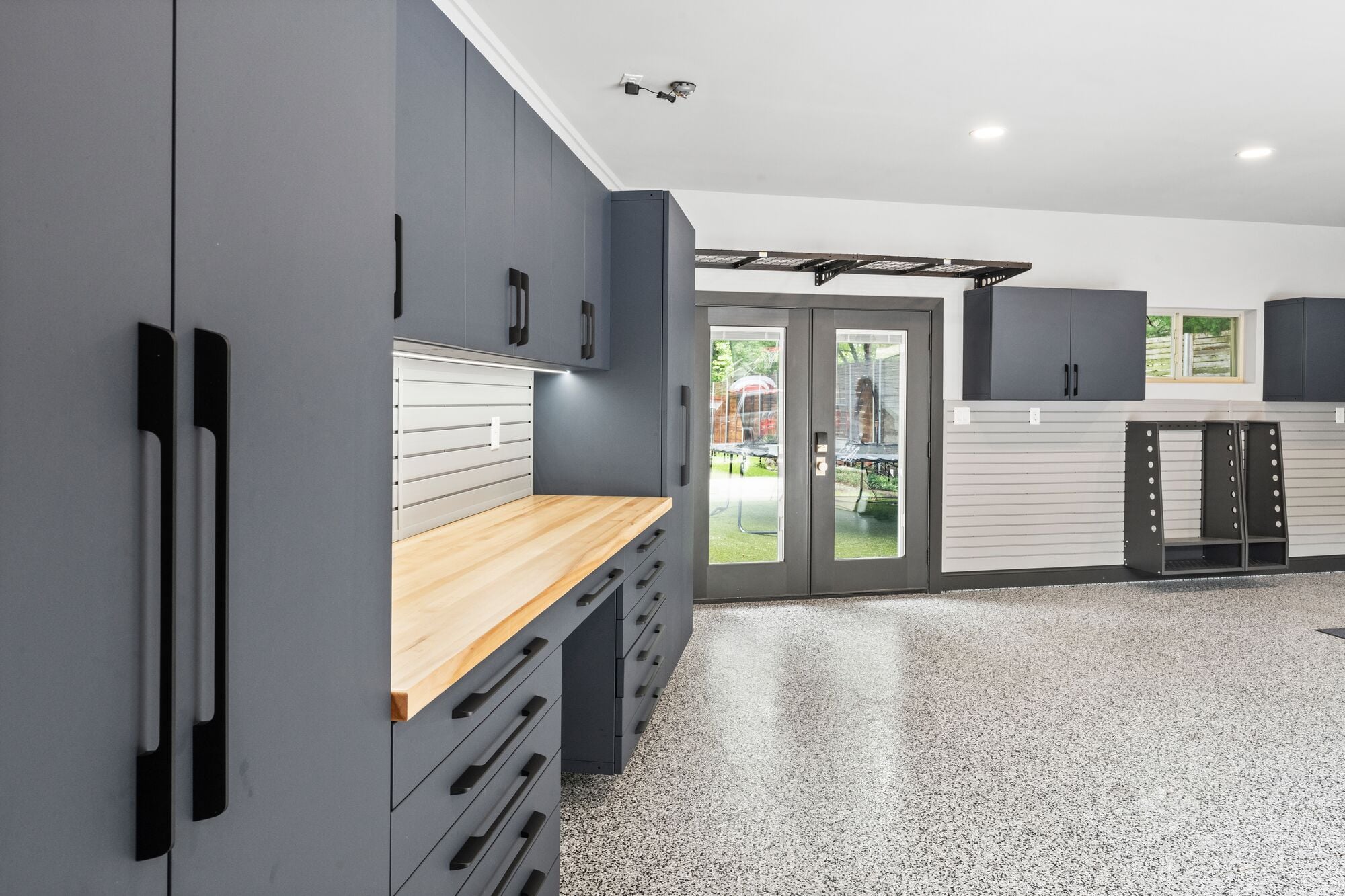
Wall-mounted slatwall systems. Rather than relying on freestanding units that compete with your floor space, professional systems use wall-mounted slatwall panels as the backbone of the organization. Slatwall is a purpose-built panel system that accepts a wide range of accessories (shelves, baskets, bike hooks, sports organizers), all of which can be repositioned as your storage needs change. It keeps gear off the floor, maximizes vertical space, and creates a visual consistency that makes the garage look intentional.
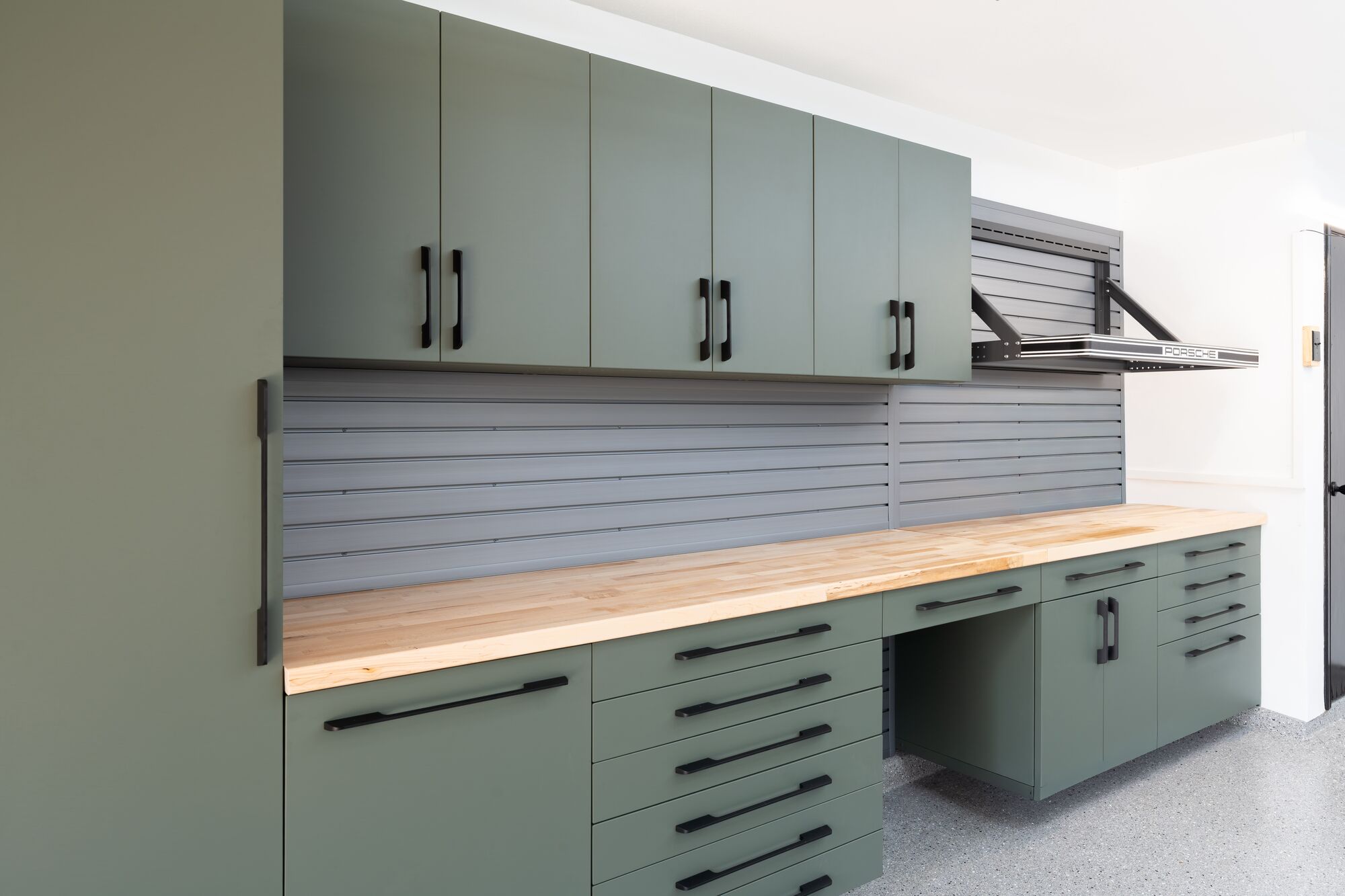
Integrated cabinetry. Professional-grade garage cabinets are built differently than furniture-grade alternatives. They're designed for the temperature swings and humidity of a garage environment, with steel or heavy-duty construction that holds its shape and its load over years of real use. They're also designed to work together: consistent heights, integrated hardware, and adjustable configurations.
Overhead storage. Floor space in a garage is premium real estate, especially when you're parking one or two vehicles. Professional overhead storage systems reclaim the ceiling space that's otherwise wasted, creating a strong, stable platform for seasonal items, bins, and gear that you need but don't reach for every week.
Flooring as part of the system. A professional garage renovation often includes a floor coating that transforms the look and function of the space. A proper floor is easier to clean, more resistant to chemicals and stains, and immediately elevates the whole space visually.
The result is a garage that functions like a room in your home: clean, purposeful, and built to last.
⟩ Top
4. Why design is the most underrated part of any garage renovation
Homeowners focus on the products. Professional designers focus on the space.
This distinction matters more than people realize. You can buy excellent individual components (quality cabinetry, strong slatwall panels, a beautiful floor coating), and still end up with a garage that doesn't work if those components haven't been planned carefully.
Garage design expertise means knowing things that aren't obvious from the outside:
Traffic flow matters. How do you move through your garage? Where do you enter from the house? Where do the kids drop their sports gear? A well-designed garage accounts for the natural paths people take so that frequently-used items are always accessible.
Vehicle clearance is non-negotiable. This is where many DIY projects fail. Professional designers plan around your vehicles, not just their parked position, but door swing radius, trunk access, and the space needed to comfortably unload groceries or gear. Cabinetry that's installed without this calculation creates friction every single day.
Vertical zoning changes everything. Experienced designers divide the garage into distinct vertical zones: overhead storage for rarely-used seasonal items, upper wall space for bins and overflow, mid-wall zones for everyday items, and lower areas for heavier, floor-accessible gear. Without intentional zoning, storage gets placed wherever there's space, which means the heaviest items end up highest, and the things you need daily are buried.
The floor-to-ceiling visual. A commonly underestimated element of professional garage design is visual continuity. Matching cabinetry, consistent slatwall panels, and a finished floor create a coherent look that makes the garage feel larger, cleaner, and more functional. Mismatched components, even good ones, create visual noise that makes a space feel cluttered even when it's organized.
A design-first approach saves money. This one surprises people. When you design thoughtfully before buying anything, you avoid purchasing products that don't fit, won't work, or need to be replaced. Homeowners who invested on garage storage are often the ones who've bought and discarded multiple retail solutions before committing to a professional system. The real cost of "affordable" is often a second or third attempt.
⟩ Top
5. The quality gap: what you're really comparing when you compare price
Price comparison is the natural instinct when evaluating garage storage. A set of metal shelves costs about $150. A custom cabinet installation costs considerably more. The gap looks obvious.
But the comparison isn't between the same things. It's between a product and a system, between disposable and durable, between something that needs to be replaced and something that doesn't.
Here's a clearer frame for thinking about quality in garage storage:
Construction materials. Retail shelving and cabinetry for garages is often made from particle board, lightweight steel, or plastic composites. Professional garage cabinetry uses steel or commercial-grade materials built to handle both the weight load and the environmental conditions of a garage. The difference shows up in years two, three, and five, not on installation day.
Hardware and finish. Professional systems use heavy-duty drawer slides, integrated soft-close hinges, and powder-coated finishes that resist chipping, fading, and moisture. Retail alternatives use lighter hardware that wears down under regular use and finishes that show age quickly.
Weight capacity. Professionally installed wall-mounted slatwall systems and cabinetry are anchored to wall studs and engineered to hold substantial weight safely and consistently. Retail alternatives are limited by their design and often require careful weight management to avoid failures.
Installation quality. A professional installation includes leveling, proper fastening, and the kind of attention that ensures everything works as it should from day one. Flat-pack retail systems are only as good as the assembly, and garage environments are not forgiving of gaps, misalignments, or improper anchoring.
Longevity. This is the number that changes price comparison dramatically. A professional garage system, well-designed and properly installed, lasts for decades. A retail system that needs to be replaced every five to six years (or sooner) costs significantly more over the same period.
The honest question should be: "How many times am I willing to pay for the wrong solution before I invest in the right one?."
⟩ Top
6. Your new garage storage decision tree
Before buying anything — another shelf, another hook, another cabinet — run your garage through this decision framework.
Step 1: What is your garage's primary function?
- Mainly parking — Storage needs to be wall-mounted and overhead.
- Mainly workshop — You need workbench integration, tool storage, and task-specific organization.
- Mainly sports and recreation storage — Slatwall with sport-specific accessories, bike mounts, and seasonal rotation zones.
- A mix of all three — You need a design professional. This is not solvable with retail products alone.
Step 2: What has failed before?
- Products broke or wore out — Quality is the issue. Retail-grade won't solve this.
- Things got disorganized again quickly — System design is the issue. More products won't solve this.
- The storage conflicted with parking — Layout planning is the issue. Professional design solves this.
- You ran out of space — You need vertical optimization: overhead storage and full wall utilization.
Step 3: What is your real budget?
- Not "how little can I spend now", but "how much am I willing to invest total over the next ten years?"
- If you've already spent $500–$2,000 on retail solutions that didn't hold up, those numbers belong in this calculation.
Step 4: Do you want this done once?
- Yes — Professional design and installation is the way to go. Custom layout, quality materials, proper installation.
- Not yet — Start with professional slatwall panels as a foundation. They're the one retail-compatible product that can be expanded into a professional system later without starting over.
Step 5: Have you accounted for your vehicles?
- If not, stop. Measure your vehicles, their door swing radius, and your parking position before placing a single cabinet or shelf. Everything else follows from this.
⟩ Top

7. FAQ: garage storage systems
Why does my garage always end up disorganized, even after I clean it?
Because cleaning and organizing are two different things. Cleaning moves items. Organizing creates a place for every item to live, and makes it easier to put things back than to set them down. Without a dedicated system that matches how you use your garage, things default to the nearest available space. The solution is intentional design.
What is slatwall, and is it worth it for a garage?
Slatwall is a wall panel system with horizontal grooves that accept a range of accessories (hooks, shelves, baskets, holders) that can be repositioned without tools. It's an extremely versatile storage solution available for a garage because it adapts as your needs change. Professional-grade slatwall is significantly more durable than retail alternatives and is designed to handle the weight demands of garage storage. And for your garage, it's one of the highest-value investments you can make.
How is professional garage cabinetry different from furniture I'd buy at a home store?
Garage cabinetry needs to handle moisture, temperature swings, heavy loads, and years of daily use in a way that indoor furniture simply doesn't. Professional garage cabinets are built from materials suited to the environment, with hardware rated for real working use. The finish is designed to resist chips, fading, and staining. Furniture-grade cabinets in a garage environment almost always fail prematurely.
How much does a professional garage storage system cost?
The range is wide and depends on the size of your garage, the scope of the project, and the products involved. A full professional garage renovation (cabinetry, slatwall, overhead storage, and floor coating) typically represents a meaningful investment. The more relevant comparison is total cost over time: homeowners who've spent money on multiple retail solutions have already spent a significant portion of what a professional system would have cost, without the durability or the results.
Does a garage renovation increase home value?
Yes, consistently! A finished, organized garage is a very noticeable feature in a home showing. It signals to buyers that the property has been well maintained, increases usable square footage, and often sets a home apart in competitive markets. A professional garage renovation is one of the few home improvements that delivers both daily quality-of-life benefits and measurable resale value.
Do I need overhead storage in my garage?
If you park in your garage, almost certainly yes. Overhead storage reclaims the ceiling space — typically eight to ten feet of vertical clearance. It's the smartest, most efficient way to store seasonal items, large bins, and infrequently used gear without sacrificing the floor space needed for vehicles.
What should I do before meeting with a garage renovation company?
Think about how your garage is currently failing. Make a list of what you store, what you park, and how the space gets used day-to-day. Note any specific pain points, things that are always in the way, items you can never find, or conflicts between storage and parking. The more specific you can be about how the space is used, the better a designer can build a system that solves the problem.
Is a garage floor coating worth it?
Yes! A professional floor coating — particularly Garage Living's Floortex — transforms the functionality and appearance of the garage. It's resistant to oil, chemicals, and tire marks, it's far easier to clean than bare concrete, and it significantly improves the overall look of the space. It's also significantly more durable than DIY epoxy kits, which are prone to peeling and discoloration in real garage conditions.
Ready to stop guessing and start planning? Talk to a Garage Living designer and see what a space built around how you live can look like.